clonal competition
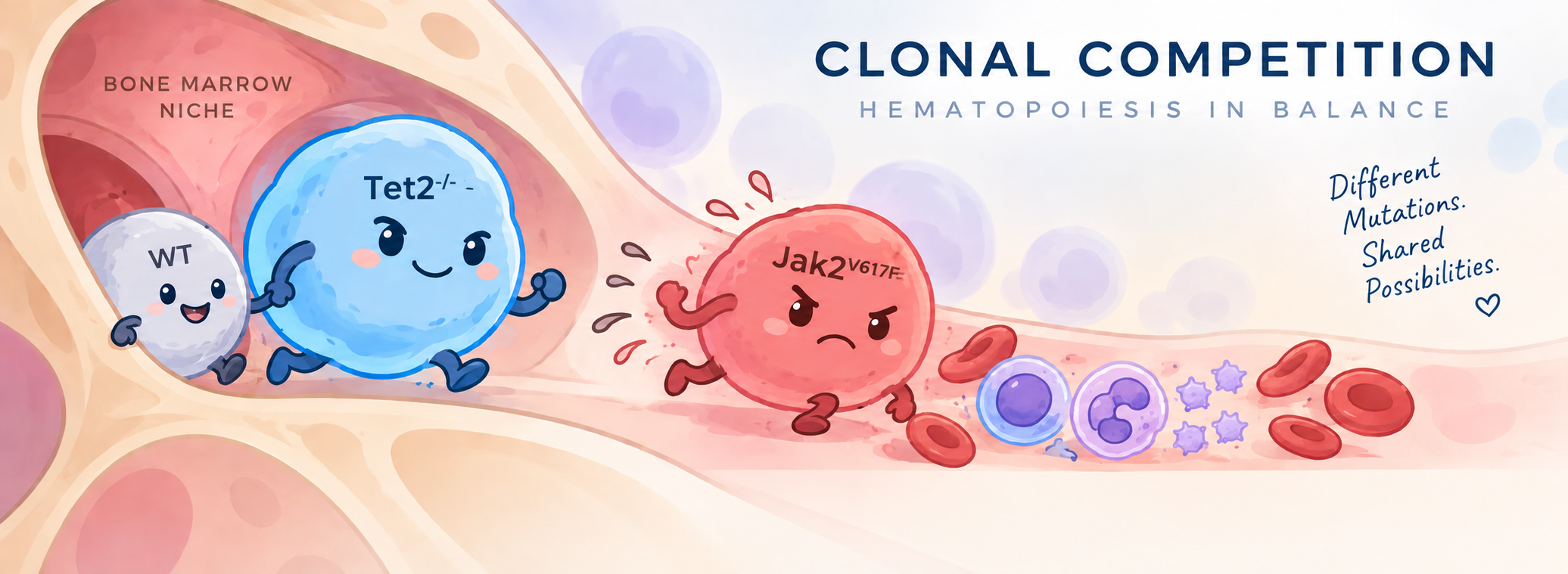
At the broadest level, we are trying to understand the dynamics that determine clonal dominance within the hematopoietic system. Hematopoiesis is a polyclonal process in which multiple hematopoietic stem cells (HSCs) may arise. Selective pressures such as aging and inflammation may allow some clones to gain a fitness advantage over others. However, individuals can harbor multiple genetically distinct clones simultaneously, meaning that the behavior of one clone may depend strongly on the other clones competing with it. Our work asks whether competition between clones can alter their trajectories and, importantly, whether the presence of one highly competitive clone can restrain the expansion and disease-promoting effects of another.
Using Tet2-deficient and Jak2V617F clones as a model of clonal competition, we are investigating how their relative fitness changes when they occupy the same hematopoietic environment. Rather than simply asking whether Tet2 loss increases HSC fitness, we want to understand how that fitness affects a neighboring malignant clone. Our observations suggest that Tet2-deficient cells can strongly restrict Jak2V617F expansion and reduce downstream disease-associated phenotypes. This raises an important mechanistic question: what properties allow one clone to dominate another? Possibilities include differences in HSC self-renewal, bone-marrow niche occupancy, homing or engraftment, lineage output, responses to inflammatory signals, or changes that one clone induces in surrounding competitor and bystander cells.
Ultimately, we want to determine whether clonal composition itself is an important determinant of disease progression. Two individuals carrying the same disease-associated mutation may not necessarily experience the same trajectory if that mutation exists within different competitive environments. By defining the cellular and molecular mechanisms governing these interactions, we hope to move from simply describing which mutations are present toward understanding how clones interact, which clones become dominant, and how those interactions influence whether hematopoiesis remains relatively stable or progresses toward overt disease.